
PVD gold-plated jewellery is designed to combine the refined look of gold with the practicality of modern materials such as stainless steel.
But even a durable finish benefits from the right care.
Jewellery comes into contact with skin oils, perfume, cosmetics, water, clothing, desks, handbags and countless other surfaces during everyday wear. Over time, these small exposures can influence how a piece looks.
The good news is that caring for PVD gold-plated jewellery does not require complicated cleaning routines or expensive products.
A few simple habits can help you preserve the finish and keep your jewellery looking polished for longer.
This guide explains the everyday dos and don’ts of caring for PVD gold jewellery, especially bracelets designed for frequent wear.
What Is PVD Gold-Plated Jewellery?
PVD stands for Physical Vapour Deposition.
It is a coating process carried out in a controlled vacuum environment. The coating material is deposited onto the surface of another metal, creating a strongly bonded outer finish.
In jewellery, PVD technology is frequently used with stainless steel to create gold-coloured surfaces with good resistance to everyday wear.
Soul Touch Jewellery uses 316L stainless steel with an 18K PVD gold finish across its gold-finish bracelet collection.
PVD finishing can be more wear-resistant than some very thin conventional plating methods, but it is still a surface finish.
That means the way jewellery is worn, cleaned and stored still matters.
Does PVD Gold Jewellery Need Special Care?
Yes—but “special care” does not mean difficult care.
PVD-finished jewellery is generally chosen because it is practical for regular use. You should not need to treat it like something that can never leave its box.
However, jewellery experiences constant physical contact.
Bracelets in particular may rub against:
- laptop edges;
- desks;
- watch straps;
- handbags;
- sleeves;
- other bracelets; and
- hard surfaces.
Reducing unnecessary friction and chemical exposure can help maintain the appearance of the finish.
The objective is simple: wear your jewellery normally, but avoid putting it through conditions that are unnecessarily harsh.
DO: Wipe Your Jewellery After Wearing It
One of the simplest jewellery-care habits is also one of the most useful.
After wearing your bracelet, gently wipe it with a soft, clean, dry cloth.
This can help remove:
- skin oils;
- light perspiration;
- cosmetic residue;
- dust; and
- surface moisture.
You do not need to polish aggressively.
A gentle wipe is enough.
The purpose is simply to prevent residue from sitting on the jewellery for extended periods.
DON’T: Use Abrasive Polishing Materials
More polishing does not necessarily mean cleaner jewellery.
Abrasive polishing cloths, rough fabrics or aggressive metal-polishing products can create unnecessary friction against a plated or finished surface.
Avoid using products designed to remove layers of oxidation from solid metals unless the jewellery manufacturer specifically recommends them.
For PVD-finished jewellery, a soft lint-free or microfiber cloth is generally a much gentler choice.
The goal is to clean the surface—not grind or polish away at it.
DO: Put Jewellery On After Perfume and Cosmetics
Your morning routine can affect your jewellery more than you realise.
Perfumes, hairsprays, lotions, creams and cosmetic products may contain alcohol, oils or other ingredients that can build up on jewellery surfaces.
A simple habit is:
get ready first, put jewellery on last.
Apply:
- perfume;
- moisturiser;
- sunscreen;
- makeup;
- hairspray; and
- other personal-care products
before putting on your bracelet.
Allow the products to dry or absorb before adding your jewellery.
This reduces unnecessary direct exposure.
DON’T: Spray Perfume Directly Onto Jewellery
A bracelet may sit near areas where fragrance is normally applied, which makes direct contact easy.
Try not to spray perfume directly onto the jewellery.
Instead, apply your fragrance first and allow it to settle before wearing your bracelet.
An occasional accidental spray is unlikely to mean immediate damage, but repeated direct exposure is unnecessary.
Good jewellery care is often about reducing repeated exposure rather than worrying about one isolated incident.
DO: Remove Jewellery Before Using Harsh Cleaning Products
Household cleaners are designed to break down grease, stains and residues.
They are not designed with jewellery finishes in mind.
Before using products such as:
- bathroom cleaners;
- kitchen degreasers;
- bleach;
- strong disinfectants; or
- other harsh household chemicals,
remove your bracelets.
Even when wearing gloves, bracelets can become trapped underneath them or exposed around the edges.
Removing jewellery first is the safer and simpler habit.
DON’T: Treat “Anti-Tarnish” as “Indestructible”
The term anti-tarnish can sometimes create unrealistic expectations.
It generally refers to jewellery designed to offer improved resistance to tarnishing or discolouration compared with some conventional materials or finishes.
It does not mean that the jewellery is completely immune to:
- scratching;
- abrasion;
- chemicals;
- prolonged moisture;
- friction; or
- physical damage.
A bracelet can be made from durable materials and still benefit from sensible care.
Think of anti-tarnish as improved resistance—not permission to deliberately expose the jewellery to every possible condition.
DO: Be Sensible Around Water
One of the most common questions about PVD jewellery is whether it can get wet.
PVD-finished stainless steel can offer good moisture resistance, but there is a difference between occasional contact with water and prolonged repeated exposure.
If your bracelet gets splashed while washing your hands, there is no need to panic.
Simply dry it gently when convenient.
For longer activities such as bathing, swimming or cleaning, removing your jewellery is a useful habit.
This reduces exposure not only to water but also to soaps, chlorine, salt and other substances.
DON’T: Assume “Waterproof” Means Unlimited Exposure
Online jewellery descriptions frequently use terms such as “waterproof.”
Consumers should interpret this language carefully.
The fact that a material tolerates moisture does not necessarily mean repeated exposure to swimming pools, seawater, soaps and chemicals will have no effect over an unlimited period.
Chlorinated water and salt water are particularly different from ordinary fresh water.
If preserving the finish is important to you, unnecessary prolonged exposure is best avoided.
DO: Store Bracelets Separately
How you store jewellery matters because different pieces can rub against one another.
Chains can become tangled.
Harder surfaces can scratch softer ones.
Clasps can catch onto other jewellery.
Whenever possible, store your bracelets individually or in separate sections of a jewellery box.
A soft pouch can also help reduce direct contact between pieces.
This becomes particularly important for bracelets with polished surfaces, because fine scratches can become more visible over time.
DON’T: Throw Jewellery Into a Handbag
It is tempting to remove a bracelet during the day and place it directly into your handbag.
But inside a handbag, jewellery may rub against:
- keys;
- coins;
- zippers;
- chargers;
- cosmetics; and
- other hard objects.
If you regularly remove jewellery while travelling or at work, carry a small soft pouch or jewellery case.
It takes very little space and offers much better protection.
DO: Clean Jewellery Gently When Needed
Everyday wiping is usually enough for routine care.
Occasionally, jewellery may need more cleaning because of visible residue.
Depending on the manufacturer’s care instructions, a gentle cleaning method may involve:
- preparing lukewarm water with a small amount of mild soap;
- gently cleaning the surface without aggressive scrubbing;
- rinsing carefully if appropriate;
- drying the jewellery completely with a soft cloth; and
- allowing it to dry fully before storing.
Do not automatically use this method on every piece of jewellery.
Always consider whether the bracelet contains stones, adhesives, decorative elements or components that require different care.
When in doubt, follow the specific care instructions supplied with the product.
DON’T: Use Toothpaste to Clean Jewellery
Toothpaste is sometimes recommended online as a DIY jewellery-cleaning method.
It is not a good default choice for plated or finished jewellery.
Many toothpastes contain abrasive ingredients designed to clean teeth.
Those abrasives can be unnecessarily harsh on jewellery surfaces.
The same applies to aggressive homemade cleaning mixtures.
Simple and gentle care is usually safer than experimenting with strong DIY methods.
DO: Pay Attention to Friction
For bracelets, physical friction is one of the most important everyday factors.
Think about where your wrist spends the day.
If you work at a computer, the bracelet may repeatedly contact the edge of your laptop or desk.
If you wear a watch next to your bracelet, the two pieces may rub together.
If you stack several bracelets, their links may continuously move against each other.
None of these things means you should stop wearing jewellery.
Simply be aware that repeated friction can contribute to normal surface wear.
A comfortable fit and thoughtful styling can help reduce excessive movement.
DON’T: Wear Too Many Heavy Bracelets Together Every Day
Bracelet stacking can look beautiful.
But several heavy bracelets rubbing against one another throughout the day create more surface contact than wearing one or two refined pieces.
If you enjoy layered jewellery, consider mixing:
- one medium bracelet with one delicate chain;
- a watch with one bracelet; or
- two lighter bracelets with different textures.
You can still achieve a layered look without turning your wrist into a collection of constantly colliding metal surfaces.
DO: Choose the Right Bracelet Fit
A bracelet that fits properly is not only more comfortable—it can also reduce excessive movement.
If a bracelet is extremely loose, it may repeatedly slide across:
- your hand;
- your watch;
- your desk; and
- surrounding surfaces.
A closer but comfortable fit can help keep the bracelet more stable.
Always check:
- bracelet length;
- extender length;
- clasp type; and
- adjustment range
before purchasing.
The right fit can improve both comfort and everyday practicality.
DON’T: Ignore the Clasp and Underwrist Area
Most jewellery photographs focus on the decorative side of a bracelet.
But working women should also pay attention to what sits underneath the wrist.
Bulky clasps or protruding components can repeatedly touch a desk or laptop.
This may become uncomfortable and can create additional surface contact.
For desk-heavy routines, smoother and lower-profile underwrist details can make a meaningful difference.
DO: Remove Jewellery Before Exercise
Exercise creates a combination of conditions that jewellery does not particularly need:
- increased perspiration;
- repeated movement;
- contact with gym equipment;
- friction; and
- possible impact.
It is generally easier to remove bracelets before exercising.
This also reduces the chance of jewellery catching on equipment or becoming uncomfortable during movement.
Your bracelet can go back on when your workout is finished and your skin is clean and dry.
DON’T: Sleep in Bracelets Regularly
Some people prefer to keep jewellery on overnight.
For bracelets, removing them before sleep can help reduce unnecessary friction, pulling and pressure.
Chains may catch against bedding.
Clasps can press into the wrist.
Links may twist or rub together during movement.
If there is no reason to wear the bracelet while sleeping, storing it safely overnight is usually the better habit.
DO: Check Your Jewellery Occasionally
Everyday jewellery deserves an occasional quick inspection.
Check whether:
- the clasp closes securely;
- extender links remain intact;
- stones or decorative elements appear secure;
- the bracelet has become tangled; or
- any component looks damaged.
Catching a loose clasp or connection early may prevent the bracelet from being lost.
This is particularly useful for jewellery worn several times each week.
What About Sweat?
Sweat is a normal part of everyday life.
You do not need to remove your jewellery every time the weather becomes warm.
However, if your bracelet becomes noticeably sweaty—after exercise, a very hot commute or prolonged outdoor activity—wipe it gently afterwards.
This removes residue rather than allowing it to sit on the surface.
For women living in warm or humid climates, this small habit can easily become part of the normal end-of-day routine.
How Should You Care for PVD Gold Bracelets Worn With a Watch?
Bracelets worn beside watches experience additional contact.
To reduce unnecessary friction:
- avoid wearing both pieces excessively loose;
- choose bracelet proportions that work comfortably with the watch;
- allow some space between the pieces where possible;
- clean each piece separately; and
- store them separately when you remove them.
If the watch is particularly large or heavy, a finer bracelet may be more comfortable beside it.
A thoughtful combination is often more practical than a crowded wrist stack.
PVD Jewellery Care for Working Women
For working women, jewellery care needs to be realistic.
You probably do not want a complicated ritual every morning and evening.
Fortunately, you do not need one.
A practical routine might simply be:
Before Work
Apply perfume and cosmetics first.
Put your bracelet on afterwards.
During the Day
Wear it normally.
Remove it only if you are doing something likely to expose it to harsh chemicals, heavy impact or unnecessary friction.
After Work
Take the bracelet off.
Give it a gentle wipe with a soft cloth if needed.
Store it separately.
That entire routine takes very little time.
What Is Normal Wear?
Even well-made jewellery can develop signs of use.
Fine surface scratches, small changes in high-contact areas and general signs of wear can occur when jewellery is worn frequently.
This is different from assuming that a piece should deteriorate quickly.
Materials, manufacturing quality and finishing all influence how well jewellery performs.
But everyday jewellery is still something that physically interacts with the world around you.
Reasonable care helps preserve its appearance while allowing you to actually enjoy wearing it.
How Often Should You Clean PVD Gold Jewellery?
There is no strict schedule.
For frequently worn bracelets, a gentle wipe after use is usually sufficient.
More thorough cleaning should be occasional and based on actual need rather than a fixed routine.
If the jewellery looks clean, you do not need to repeatedly wash or polish it.
Over-cleaning can be unnecessary.
The simplest approach is:
wipe regularly, clean gently when required, and avoid harsh treatments.
A Simple PVD Gold Jewellery Care Checklist
For everyday use, remember these habits:
DO
- Put jewellery on after perfume and cosmetics.
- Wipe it gently after wear.
- Store pieces separately.
- Remove bracelets before harsh cleaning.
- Check clasps periodically.
- Use gentle cleaning methods when necessary.
- Dry jewellery thoroughly after moisture exposure.
DON’T
- Use abrasive polishing products.
- Spray perfume directly onto jewellery.
- Store jewellery loose with keys or hard objects.
- Use toothpaste or harsh DIY cleaners.
- Regularly expose jewellery to chlorine or harsh chemicals.
- Assume anti-tarnish means indestructible.
- Ignore excessive friction between bracelets and watches.
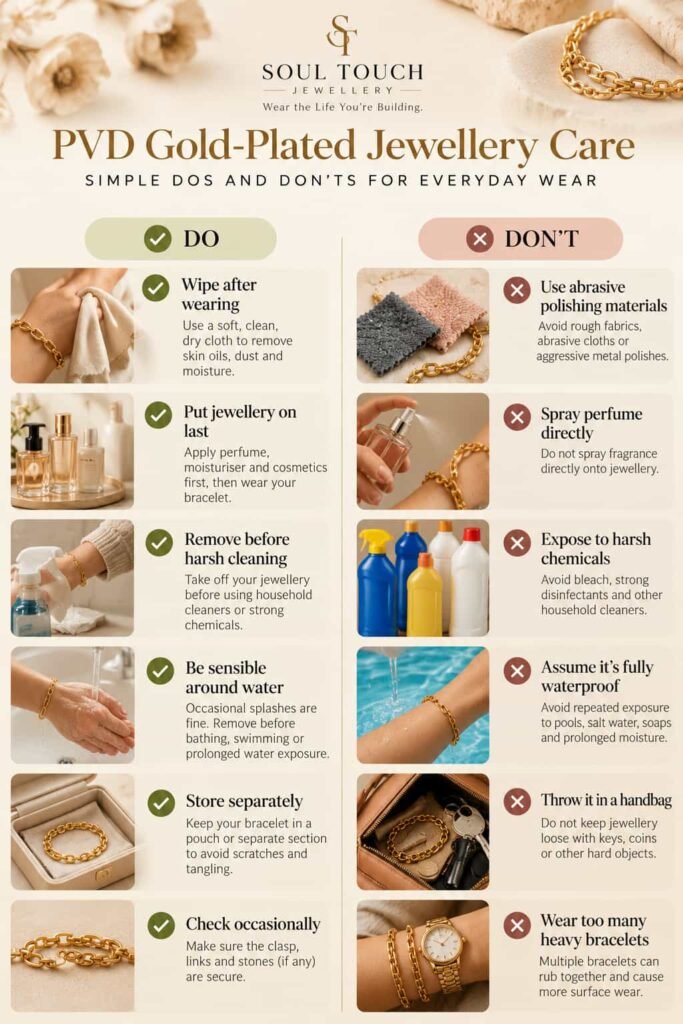
Simple care habits to help preserve PVD gold-plated jewellery during everyday wear.The Final Takeaway
Caring for PVD gold-plated jewellery is less about complicated cleaning and more about everyday habits.
Wear your jewellery.
Enjoy it.
Let it become part of your normal wardrobe.
Just give it the same reasonable care you would give other items you want to keep looking good.
Apply perfume before putting jewellery on.
Avoid unnecessary chemical exposure.
Reduce excessive friction.
Wipe your bracelet gently after wear.
And store it properly when the day is finished.
For working women, jewellery should be practical enough to move through real life—from the morning commute to the office desk and into the evening.
Good care simply helps it make that journey with you.