
A beautiful bracelet can completely change the way an outfit feels—but only when it fits comfortably.
Too tight, and it can feel restrictive during a long workday. Too loose, and it may constantly slide over your hand, move around while typing, or feel insecure when you are on the go.
Knowing how to measure your wrist for a bracelet before buying online can help you choose a fit that feels comfortable, looks balanced and suits the way you actually live.
Whether you prefer a delicate chain bracelet, structured link design or adjustable everyday style, this simple bracelet size guide will help you measure correctly and understand what kind of fit may work best for you.
Why Bracelet Fit Matters
Bracelet sizing is not only about whether the jewellery closes around your wrist.
The right fit affects how the bracelet:
-
- sits against your skin;
-
- moves while you work or type;
-
- pairs with a watch;
-
- layers with other bracelets;
-
- feels after several hours of wear; and
-
- looks in proportion to your wrist.
This is particularly important for jewellery worn from morning to evening.
For women moving between meetings, commuting, laptop work, coffee breaks and evening plans, a bracelet should feel polished without constantly demanding attention.
Chain and link bracelets generally benefit from a little breathing room rather than sitting completely tight against the wrist. Tiffany’s sizing guidance similarly distinguishes between snugger cuffs and bangles and link or chain bracelets that need some room for movement.
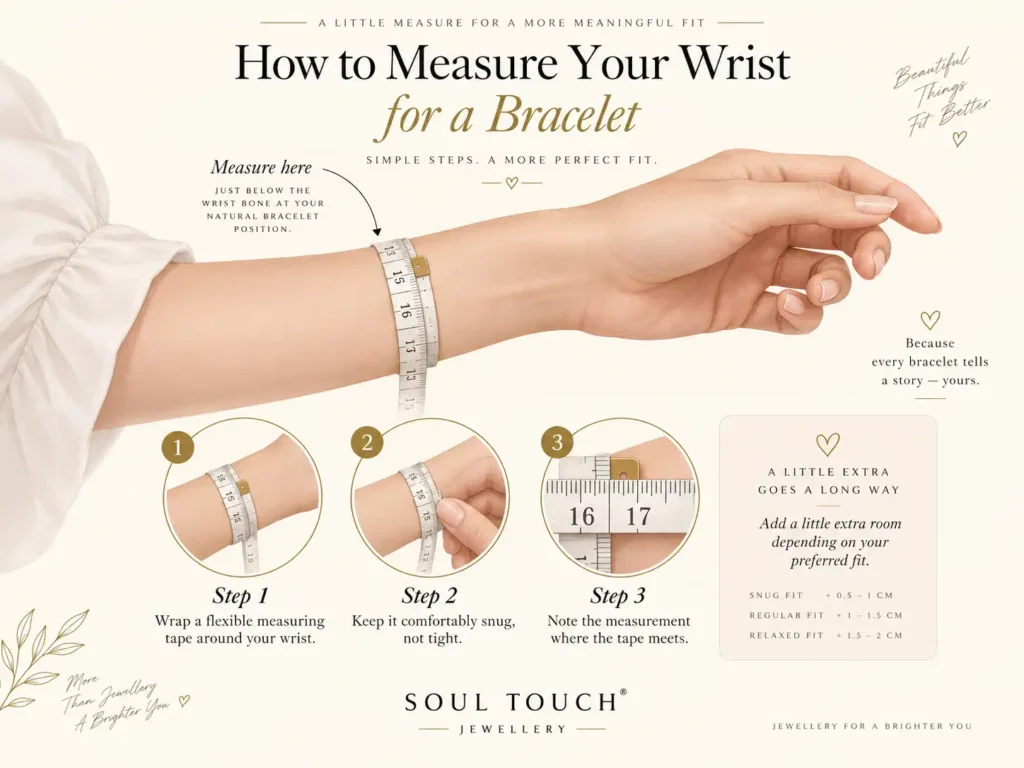
How to Measure Your Wrist for a Bracelet
You only need a flexible measuring tape.
If you don’t have one, use a piece of string, ribbon or a narrow strip of paper and measure it afterward against a ruler.
Step 1: Choose the Wrist You Will Wear the Bracelet On
Measure the actual wrist where you normally wear your jewellery.
Your left and right wrists may not measure exactly the same, so don’t assume that one measurement automatically applies to both.
If you normally wear a watch on one wrist and your bracelet on the other, measure the bracelet wrist.
Step 2: Wrap the Measuring Tape Around Your Wrist
Place the tape around the wrist just below the wrist bone—approximately where you would naturally want your bracelet to sit.
Keep the measuring tape comfortably against the skin.
It should not squeeze your wrist, but it should not be hanging loose either.
Step 3: Note Your Wrist Measurement
Read the measurement where the tape meets.
For example, your wrist may measure:
15.5 cm
That number is your wrist circumference, not necessarily the final bracelet length you should purchase.
This distinction matters.
Step 4: Decide How You Like Your Bracelet to Fit
Some women prefer a bracelet to sit relatively close to the wrist. Others prefer visible movement and a softer drape.
A practical starting point is:
| Preferred Fit | Starting Allowance |
|---|---|
| Close/snug fit | approximately 0.5 cm |
| Comfortable everyday fit | approximately 1–1.5 cm |
| Relaxed/looser fit | approximately 1.5–2 cm |
These are useful starting points rather than universal sizing rules because bracelet construction also affects the fit.
For example, a rigid bracelet behaves differently from a fine chain bracelet. Tiffany recommends approximately 1.27 cm of additional room for a relaxed chain-bracelet drape, while Pandora’s sizing recommendations vary according to the bracelet style itself.
So if your wrist measures 15.5 cm, a bracelet around 16.5–17 cm may be a useful starting point for a comfortable everyday fit—but always check the measurements given on the individual product page before ordering.
Bracelet Size Is Not the Same as Wrist Size
This is one of the most common mistakes when shopping for bracelets online.
If your wrist measures 16 cm, that does not necessarily mean you should buy a bracelet measuring exactly 16 cm.
A bracelet that matches the wrist circumference exactly may feel too tight because it leaves little room for natural movement.
The bracelet’s:
link size, thickness, clasp, structure and adjustability
can also change how it feels once worn.
This is why reputable sizing guides recommend measuring the wrist first and then choosing the bracelet according to the construction and desired fit rather than relying only on a generic size label.
How Should an Everyday Bracelet Fit?
If you are choosing jewellery for regular daily wear, explore our everyday gold bracelets designed for polished, comfortable styling.
You should be able to move your wrist naturally while working, driving, carrying a handbag or using your phone.
For many women, a comfortable chain or link bracelet should have enough movement to feel relaxed but should not repeatedly fall over the hand.
Try this simple test:
When the bracelet is on, slide one finger gently between your wrist and the bracelet.
If it feels comfortable and the bracelet can move slightly without slipping excessively toward your hand, the fit is usually suitable for everyday wear.
Personal preference still matters, so treat this as a practical guide rather than a strict sizing rule.
Choosing Bracelet Fit for Office and Laptop Wear
A bracelet can look beautiful while standing in front of a mirror and still become irritating after several hours at a desk.
If you spend much of your day working on a laptop or keyboard, consider:
how far the bracelet moves down your wrist, the size of its links, whether the clasp sits underneath the wrist, and how much movement you prefer while typing.
A very loose, heavy bracelet may repeatedly contact your desk or laptop.
A bracelet that is too tight can feel restrictive during long periods of wear.
A comfortable middle ground is usually better for workday jewellery—secure enough to stay near the wrist while still allowing natural movement.
This is one reason adjustable chain and link styles can be useful for everyday wardrobes.
What If the Bracelet Is Adjustable?
Adjustable bracelets provide more flexibility than fixed-size designs.
Depending on the style, adjustment may come from:
an extender chain, sliding mechanism, multiple clasp positions or adjustable links.
If a product is adjustable, check both:
the minimum wearable length and the maximum wearable length.
Then compare that range with your wrist measurement.
Do not simply assume that “adjustable” means the bracelet will fit every wrist.
The individual product specifications should always take priority.
How to Measure Without a Measuring Tape
No measuring tape? You can still measure accurately.
Wrap a piece of non-stretch string or ribbon around your wrist at the point where you normally wear a bracelet.
Mark the point where the two ends meet.
Lay the string flat beside a ruler and measure the length in centimetres.
Avoid stretchy thread because it can distort the measurement.
A narrow strip of paper also works well.
Should You Size Up If You’re Between Bracelet Sizes?
Usually, choosing the slightly larger option is safer when you fall directly between two fixed bracelet sizes—particularly if you prefer a relaxed fit.
Pandora similarly recommends moving to the next size when between available sizes.
However, consider the bracelet design first.
If the bracelet includes a generous extender, you may already have enough adjustment.
For chunky or larger link designs, a little additional room may also help the bracelet sit naturally.
Does Bracelet Style Affect Sizing?
Yes.
A delicate chain bracelet, chunky link bracelet, rigid bangle and sliding bracelet will not necessarily feel the same even if their listed measurements appear similar.
Chain Bracelets
Chain bracelets are flexible and generally follow the natural movement of the wrist.
A small amount of breathing room usually creates a comfortable everyday fit.
Link Bracelets
Link size and thickness can affect how closely a bracelet sits.
Larger links may require slightly more room than a very fine chain.
Adjustable Bracelets
These offer the most flexibility because the wearer can modify the fit within the bracelet’s available range.
Bangles
Because bangles are rigid, sizing often depends on both the wrist and hand dimensions, particularly when the bangle needs to slide over the hand.
Always follow the sizing method given for the specific design.
Bracelet Fit When Wearing a Watch
If you plan to wear your bracelet beside a watch, don’t automatically choose an excessively loose fit.
The bracelet should have enough movement to look natural without constantly sliding over the watch face.
For a polished office look, consider placing a refined chain or link bracelet beside the watch with enough separation that the two pieces do not continuously rub against each other.
We will cover watch-and-bracelet styling in a separate Soul Touch Jewellery guide.
Common Bracelet-Sizing Mistakes
Avoid measuring over clothing or a watch.
Don’t pull the measuring tape extremely tight.
Don’t assume your usual clothing size determines your bracelet size.
Don’t assume every brand uses identical sizing.
And most importantly, don’t buy purely based on labels such as Small, Medium or Large without checking the actual centimetre measurement.
Finding the Right Bracelet for Your Everyday Life
The best bracelet fit is one you barely have to think about.
It should feel comfortable during your workday, sit beautifully with your clothes and move naturally with you into whatever comes after office hours.
At Soul Touch Jewellery, our bracelet selection focuses on refined gold-finish designs for modern women—from understated everyday chains to more distinctive link styles.
Explore Soul Touch Jewellery’s gold chain and link bracelets and check the individual product specifications to find the style and fit that works for your everyday life.
FAQs
How do I know my bracelet size?
Measure your wrist circumference with a flexible tape around the area where you normally wear your bracelet. Then check the size and adjustability information provided for the specific bracelet rather than assuming your wrist measurement is the exact bracelet length you need.
How much bigger should a bracelet be than my wrist?
It depends on the bracelet design and your preferred fit. As a general starting point, around 1–1.5 cm of additional room can create a comfortable fit for many chain bracelets, but always check the individual product specifications.
Should a bracelet be tight or loose?
A bracelet should feel secure without restricting movement. For everyday wear, many people prefer enough room for slight movement while avoiding a fit so loose that the bracelet repeatedly slides over the hand.
What should I do if I am between two bracelet sizes?
For fixed sizes, choosing the next size up is often more comfortable, especially if you prefer a relaxed fit. For adjustable bracelets, first check whether the available adjustment range already covers your wrist measurement.
Can I measure my wrist without a measuring tape?
Yes. Wrap a non-stretch string, ribbon or strip of paper around your wrist, mark where the ends meet, and measure the marked length with a ruler.